Sunday, February 27, 2011

Starting Your Own Professional Photography Business


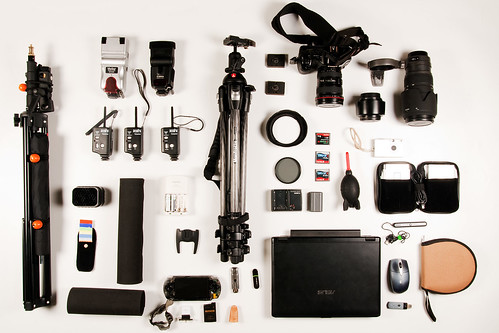
Photography in a Rucksack by Daily Travel Photos .::. Pius Lee


Photo Credit: celtics baby clothes


So now you have the desire and determination to make it work, but what will you do? Photography is your passion, or is it? There are hundreds of photographers out there no matter where you live; what makes you so different from all the other photographers?

* Do you have the unique style necessary to attract the crowds to your camera?


* Can you survive in the cut-throat business of shooting day in and day out whoeversteps in front of your camera?


* Are you original and creative enough to think of different poses, create various styles of portraits of babies, families, couples and single people and still think sanely?

If you answered these questions positively, you may be on your way but that’s not all it requires. Though photography seems a fairly easy business where in movies and television you see a young man photographing beautiful women in studios or on exotic locations, selling all the images to magazines or having huge billboards displaying his pictures, that’s just a dream. Reality can be quite different from what many think of this profession.

It takes more than a fancy camera in this day and age to make a person buy your pictures, let alone to make a business out of it, surviving on income made with your photography. If you live in Spain or anywhere else, if there’s other photo studios then you’re competing against those already established with a good clientele. How can you compete against them?

Here are some recommendations to help you build your dream of working as a photographer:

a.       Create an unique style that stands out from the other photographers


b.      Be professional at all times


c.       Display only your best images to possible clients and change these often


d.      Offer specials to advertise yourself and your photography


e.       Have exhibits of your photography to help spread word of your new business


f.        Be patient and be sure to have a good supply of backup funds in the case they don’t come

Let’s discuss the above points….  This will help you to understand how to succeed.

Look at those you will be competing against; what do they offer in their photographic services? Can you offer the same or more? Most importantly, how does your style of capturing a scene or a face stand up against theirs? You will need to establish that style before you can start with a business. Be sure in what you do and do only that.

When you work with a client, you must maintain a professional environment at all times. In my many years behind a camera, I have seen amateurs make many mistakes during events, weddings and other assignments. In some cases, it wasn’t a mechnical or technical error but a public relations mistake – some people just don’t know how to work with the public. If you do the same, you will not last for very long. While people talk a lot of good images, they talk even more about how terrible a session was. You don’t want that type of advertisement. Research your assignments, know the light. If you have new equipment, then be sure you know what they can do and how you can use it. There’s nothing worst than finding out the hard way a flash or a new lens isn’t completely “right” in your hands.

Advertising yourself is the most important thing you can possibly do; no matter how good (or bad) you think you are, if nobody knows of your services or product, then you wont sell many if at all. When you display a poor image, then others will see the faults also – never display an image that is in bad taste. Show only your best work and watch people contact you. If they see bad results, they will stay away. Your best form of advertisement is word-of-mouth from a satisfied client!

While you may be one who doesn’t believe in the “store specials”, this method of advertising does work, and you can make it work to your benefit. A special attracts people who normally wouldn’t buy a product but does due to the price offer, or does buy and sees a special pricing as a reward for their loyalty. Act on that thought and you will see more customers contacting you!

Many people go to art exhibitions to see art – when this exhibit involves portraits of people for example, it can draw in customers from a different area you never thought possible. While many go for two main reasons – to see art and enjoy it, or to buy art for themselves – having an exhibit consisting of portraits for example, encourages possible interest in becoming a subject for your camera. It also works in a different direction, establishing your track record and building on your resume to show people interested in your experiences and awards, etc. in photography.


Lastly, starting a business is not easy or as “easy” as you may think photography may be. This profession is no exception to the rule. These days everyone having a digital camera makes them a “photographer”. Who will pay you to create their memories to last a lifetime? Before you actually start your new life in photography, be sure to have a good sum of reserve cash banked away to maintain your living expenses through the lean months – if that is the case. In most new businesses, the first two years can be the hardest and patience can save your sanity! The biggest mistake here is that after two or so years of little or no business, new businesses will close, but that is wrong! That’s the worst time to close as now you already have yourself in people’s minds: seeing the storefront, knowing you’re a photographer, etc. stick it out just a bit longer!

Six Tips to Help You Clean and Organize Your Photography Studio


Cuba Gallery: Urban / retro / vintage / color / bird / design / light / photography by ►CubaGallery


photo source


1. Photography Studio Organization - Use good old fashion hanging files.

Believe it or not, in this digital age, the classic green hanging folder is still a great organization tool. Using manila folders to organize your photography studio's bills, invoices, and receipts is a good start. It is a lost cause however, if you don't have an organized place to put them. The hanging folder is the perfect place to put them

Don't have a filing cabinet to put the hanging folders in? Not a problem. There are several options available at your local retail store. I prefer the clear Rubbermaid bins. They are about 8 inches wide. This means they are easily stored in closets or on a bookshelf. Since photography studio space is usually valuable real estate, these smaller file boxes might be the way to go.

2. Photography Studio Organization - File your files

A great way to keep your files organized is to keep a file of all your files. What do I mean by this? Keep a piece of paper in your photography studio with all of your file folders on with their names. If the folders have sub-folders, list those too.

This will let you see if you have folders that overlap so that you can condense your folders. For example, there is no point in having studio file and a studio equipment file.

You could have this list written on a piece of paper, but that would just be one more piece of paper to file. Try keeping this record in a word or excel document. That way you have one less piece of paper in your office and you can update it much easier when you add new folders and files.

3. Photography Studio Organization - Throw things away

For some reason most photography studio owners have a fear of throwing client paperwork and photos away. There are certain things that you just don't need to hang on to. If you are a digital photographer there is no reason to hold on to basic prints. Create a varity of back-ups and toss the prints. You can always re-print them. If you aren't a digital photographer and have a traditional photography studio, invest in a scanner. This way, if you must hold on to prints for color purposes, you can scan them and toss the print.

There are some things you need to hold onto though.

Tax items are one thing you should hold onto. You should save your tax returns forever. The rest of your tax reports and receipts should be saved for no longer than six years.

Throw away papers that you don't have an immediate need for, can get a copy of easy, or that don't have any tax or legal reason to hold on to.

If you feel like you need to hold on to all your photography studios paperwork, than try scanning it all onto a portable hard drive. Then you can throw all the papers away. It will take more time than growing through all the papers away, but at least the hard drive will take up less space in your office.

You can scan model's head shots for reference later. You can scan pose ideas from magazines so you don't have clipping all over your photography studio.

4. Photography Studio Organization - "Assorted" Folders

How many other, assorted, or misc files do you have in your photography studio? You know, the folder that you put everything in that you just don't know where else to put it. That isn't organization. Odds are you can just throw it away altogether. A good rule of thumb is, if you haven't needed it or touched it in a year then toss it.

5. Photography Studio Organization - Get rid of business cards

There are so many ways to organize all your business cards, model head shots, and contact information. There are plenty of ways to get rid of it altogether as well. A simple approach is to take the business card or headshot and tape it or staple it the file folder it is associated with. At least then it is filed away instead of in a pile on your desk or in a drawer.

There are lots of gadgets out there made for scanning in business cards to your computer. If you are a digital photography studio, you probably already have a scanner, put it to good use. If you don't have the money for one of these than just take some time to enter the contact information into your electronic address book. Outlook has a great address book or you could even use your email clients address book. Anything is better than having them just laying around waiting to get lost.

6. Photography Studio Organization - Use the computer

Try using your photography studio's computer as much as possible. Use it to make your to-do lists, create address books, file documents, and more. The more you keep or put into your computer the less you have in your photography studio.

As I mentioned before, there are plenty of gadgets out there that can help you scan your files into the computer. Take advantage of them!

Saturday, February 26, 2011

Shooting for Stock Photography


Cuba Gallery: Urban / retro / vintage / color / bird / design / light / photography by ►CubaGallery


source,image source


A great way to earn money and learn a lot in the internet is participating in stock photography. Stock photography has been around for a while. And there are a lot of great stock sites that sell photographs for a reasonable price.

Just how and what should you shoot to be able to participate in stock photography?

Photographers say you should start with the concept. But the very first thing you should do is to know your equipment. I literally spent ten times more time trying to know how my camera works than thinking of something to shoot.

Stock photography is a very demanding industry. It's as close as you'll get to professional photography. It requires you to be able to produce images of the highest quality. That is because this industry is very competitive.

Try shooting the same subject with different settings. You should know how your camera reacts with different kinds of light. You should also know how it responds to different levels of illumination. Note the differences you see and keep them in mind.

Next you need a concept. Your images should present an idea, a thought or an expression. Consider a photograph of a man typing on a computer. What is he doing? Why is he typing? Is he working? Is he Blogging? Or just playing?

Designers buy stock images because of the concept they present - not because they look good. Stock photos are used in web sites, brochures, magazines, publications, advertisements, and almost anything that has a print.

So you need to have an image that has a concept that satisfies the needs of the would-be buyers of your pictures.

Then, you need a lot of light. Stock photos require that images have the right level of illumination and contrast. They need to be clear. If you can't afford a big set-up, you can always use desk lamps or even the sun.

You'll also need a computer and two kinds of programs: noise reduction tool and a photo editing application. Most stock photographs go through a noise reduction process. They also get a little tweaking in color, contrast and brightness.

Stock photographs need to be as close to perfect as possible. It's like what they say in the computer graphics industry: "it does not matter how you do it as long as you get the job done." Don't think that editing a photo in your pc is cheating. That only goes for journalism.

The next is pretty simple. You need a stock agency to upload your images to. Or you can showcase your work in your own site. Uploading in stock agencies is better. That is because you can find out where and how to improve. Use their powerful community to find out your weakness and strengths as a photographer.

Then when you have all this, what you need to do next is to be consistent and improve and improve and improve. You need to keep up with the ever demanding industries. If you don't, you'll get left behind.


Photography Insights and Techniques


Cuba Gallery: Portrait / smoke / hand / green / texture / woman / photography by ►CubaGallery


credit


One might ask what photography is. What is the purpose of taking a photograph? For some, just a simple snap shot will do but, for others, there is more of a destiny to experience in the photograph. Photography captures a split second in time or, simply put, a moment captured in a blink of an eye. Photographers create illusions of realism which resembles the existent world with content and form that are inseparable. In effect, the photographer has generated a story all their own. 

Photography is made from anything perceived. Seeing is believing when the moment is captured on film regardless of the subject matter. No matter how many pictures are taken of the same subject by different individuals, the photographs will never be the same “style” because the subject is in the eye of the beholder. For example, you may like that shiny red 57’ Chevy in the front of the coffee shop, so you take a photograph. Your friend loves the seat in front of the coffee shop window with the reflection of the 57’ Chevy in the glass. There are two distinctly separate shots of the same subject but, emotionally, they are very different images. No two artists are identical and different viewers will never see the same photograph in the same manner. Photographs generate a mood that creates an emotion and they can be background or landscapes or nothing but a mere rust spot with texture. 

Photography not only captures that instantaneous moment in time but also captures a visual reality. Photography, when it was first invented, was used to represent the world accurately with little room or depiction of artistic ability. Thus, the photographer could have been anyone in the crowd, and that person brought forth the way things looked at the time—showing the world what is to be perceived. 

This is not the ways of photography in the 20th century. Photography is now a truly unique art form, and a photograph can hold two and three dimensional space, as well as a one point perspective. Photography gives us the opportunity for aestheticism our everyday world. Our attention is focused on what we would normally dismiss our attention focuses on seeing beyond the believable giving a visual sensation to our minds. A photograph can be captured in one-sixtieth of a second by the shutters of the camera. In effect, art happens in the “blink of an eye”. 

Since Kodak introduced the first hand held camera in 1888, giving photography a new mission and meaning, the world has never been the same. However, the technological advances have affected photography. It has strengthened the use of a camera and allowed the photographer far more precise subjective perceptions of the subject matter. According the book The World of Art, Life Magazine started publication in 1936, and American photography used photography as their tool of disclosure. “Pictures can be beautiful, but must tell facts too,” reveals the text. Photographers must include real life recognition with lines and rhythms of the surface because, without this, the photograph would be unresponsive. As an interesting insight, a horizontal photograph is peaceful; a photograph with less foreground brings dramatization and a photograph with more foreground shows nature connected with unity. 

Photography is different than other art medium, yet the classical compositions brought together by the artists of yesteryears are still used. Photography has many techniques and art forms that differ greatly. For instance, there is black and white photography that the photographer can develop easily in even a small amount of space. According to photographer and Professor of Art Mike Wonser, a dark room can be set up in a bathroom. The light must be blocked out, but the photographs can be developed in the bath tub! So, you do not need much space to work and it is magic to watch the photograph appear. Another simple technique was shared by George Jolokai. He stated “a photographer can carry a bottle of water to add shininess or reflections on the subject matter”. The magic of photography is endless. 

Another tool used in photography is the use of slow or fast shutter speeds. Slow shutter speeds can blur water, but the use of slow shutter speeds requires a tri-pod to prevent blurring the entire photograph. The water will blur because water is in constant motion but the background or other subject matter in the photograph remains still. 

Another form of photography is that of color photography. Color brings depth and musical rhythm and is a very powerful tool to the human senses. Color photography creates a complex interplay between form and content that can create dynamic color contrasts. The photograph process takes time because critical technical decisions must come from the photographer before the release of shutter that results in the capturing of an essence of time and mood on film. 

The basic elements of style, composition, and technique are the photographer’s tools for structure; it is the photographer’s imagination that leaves an impression embedded the minds of the viewer.

References 

Joloki, George (2004, Spring). Lecture Art 101, Central Oregon Community College, Bend< Oregon 

Sayre, Henry M. (2004) A World of Art (4th ed.) Pearson Prentice Hall. 

Wonser, M. (2004, Spring). Art History 203, Central Oregon Community College, Bend< Oregon